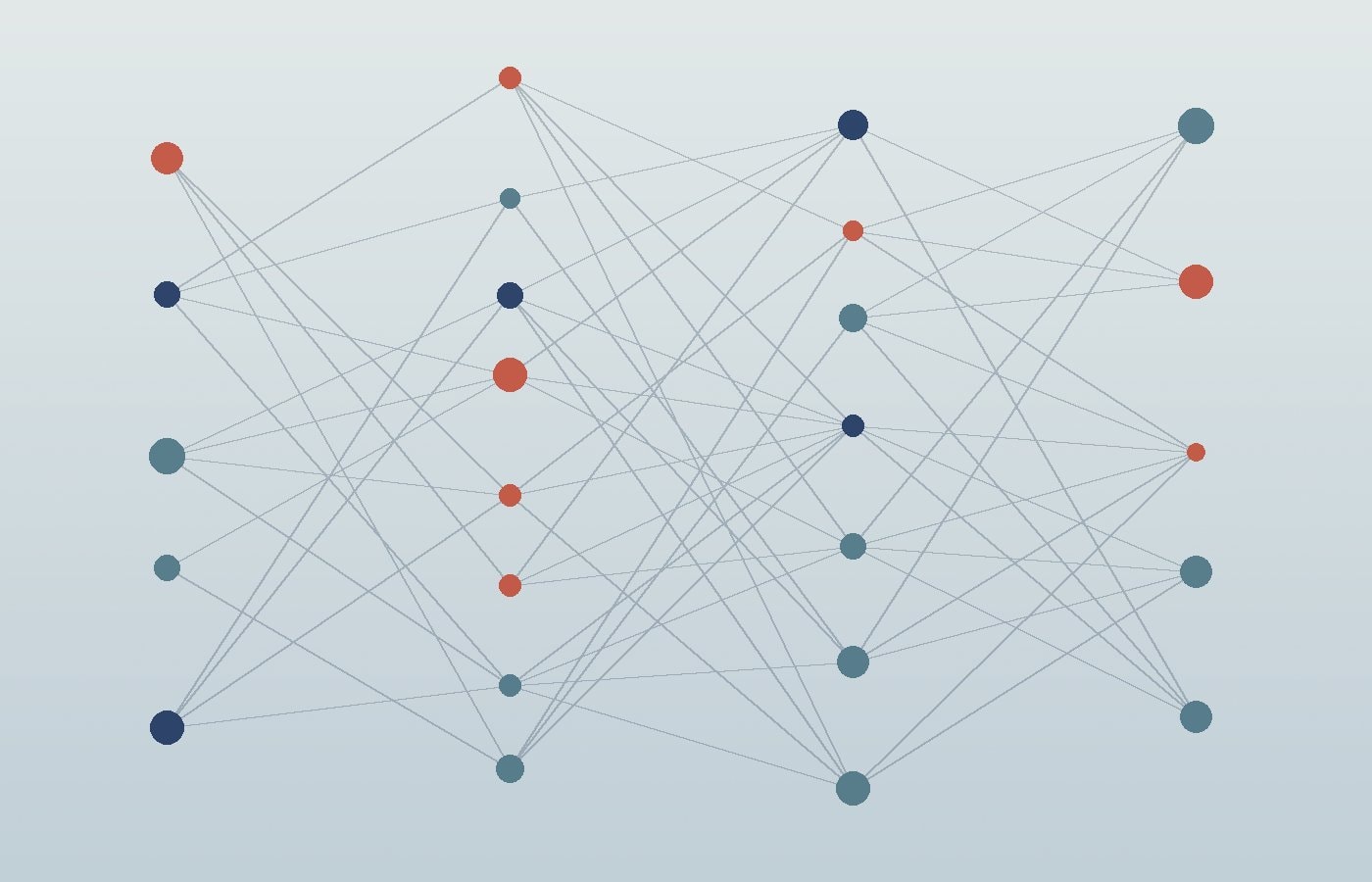
A model is a selective description
A biological neuron is a living cell with a membrane, branching processes, many kinds of channels and receptors, and a history that changes its responses. An artificial unit is a mathematical operation. It receives values, combines them and produces an output according to a rule. The simplification is deliberate: a model keeps features needed for a question and leaves others aside.
Confusion begins when similarity is treated as identity. A network that classifies images does not thereby explain vision. A circuit model that reproduces an activity pattern does not establish that the brain uses the same mechanism. Models are most informative when their assumptions are explicit and when experiments can distinguish their predictions from alternatives.
Hebb’s rule and changing connections
Donald Hebb proposed a learning principle in which repeated coordinated activity between cells could strengthen their connection. The Hebbian theory overview explains the idea and its place in accounts of learning. The principle is often shortened into a slogan, but scientific use requires details about timing, direction, stability and the biological mechanism involved.
Hebbian ideas link two levels of description. At the synapse, activity may change the efficacy of transmission. At the network level, many changing connections can alter which patterns are represented or recalled. Real nervous systems also require processes that limit growth, maintain stability and respond to context. A useful learning theory must explain balance as well as strengthening.
Logical neurons and the perceptron
Warren McCulloch and Walter Pitts described an influential formal neuron that connected neural inspiration with logic. Frank Rosenblatt’s perceptron then placed learning at the centre of a trainable system. The history of artificial neural networks sets these developments within the longer path toward multilayer networks.
These models were powerful because they made questions precise. Which patterns can a particular architecture separate? What changes when layers are added? How should connection strengths be updated from error? A mathematical answer can reveal both capability and limitation. Periods of enthusiasm and criticism in network research often followed changes in how those limits were understood.
The neocognitron and layered vision
The neocognitron is a hierarchical, multilayered network proposed in 1979. The neocognitron overview describes its influence on later convolutional neural networks. Its layered arrangement addressed how a system might recognise patterns despite changes in position, using local connections and stages of feature processing.
The Japanese Neural Network Society credits the neocognitron to one of its founders and places that work among the roots of deep learning. The historical connection is one reason the society’s participation in Neuro2013 matters: Japanese neural-network research linked biological inspiration, mathematical theory and engineered learning systems over a long period.
Computational neuroscience
Computational neuroscience studies nervous systems with mathematical models, simulations and quantitative analysis. The field overview spans levels from membranes and individual cells to networks, cognition and behaviour. A detailed biophysical model and an abstract decision model can both be valid when matched to the right question.
The field creates a cycle between theory and experiment. Data constrain possible models. A model reveals which variables matter and suggests a measurement that could separate explanations. Unexpected data then force a revision. That cycle differs from building a system solely for performance, although methods developed for one goal can help the other.
Two-way influence without equivalence
Artificial networks offer tools for analysing complex data and examples of how learning can emerge from many adjustable connections. Neuroscience offers rich problems involving adaptation, efficiency, robustness and embodied behaviour. Each can inspire the other without implying that a high-performing machine works like a brain or that biology should be judged as an engineering design.
The broader programme context is on the science on the programme. Chemical communication, which many abstract networks omit, is explored on the neurochemistry page. The institutional home for this intersection appears on three societies, one meeting.
What comparison can and cannot do
Comparing brains and artificial networks is most useful at the level of a clearly stated problem: learning from limited data, maintaining stable activity or representing changing input. Broad declarations that one system is like the other conceal differences in material, development, energy use and purpose. Exact comparisons create better questions for both fields.